The decision to farm tilapia in our backyard started out as more of a gardening hobby. We liked how tilapia took on the flavor of whatever preparation we decided to use on any particular night so it was already our fish of choice. We started with a few Blue tilapia and after nine months of feeding them, they were all over one pound and ready to feed us.
The difference between our own backyard farmed tilapia and store-bought was incredible. First of all, we never really noticed the brownish tint that store-bought tilapia had until we saw the beautiful white filets that our own tilapia had. That first year we werent particularly concerned with water clarity. We figured that the water that they originate from in Africa and the Middle East couldnt have been any cleaner than ours, so we relaxed a bit on the clarity. But then we started thinking, how bad did the water have to be to stain the insides of the store-bought fish a brownish color. Well, we did some google research and found out. I dons suggest that anyone repeat our searches, you may not like what you find. Lets just say that the tilapia farmers in Indonesia, China and Honduras (but especially China) arent raising their harvest in the cleanest water.
After cooking our first backyard farmed tilapia topped with our own paprika yogurt sauce (plain yogurt, sugar, paprika) and pico de gallo (tomatoes, white onion, cilantro) piled high on top, we immediately tasted the difference. Ours had a clean flavor that we have never experienced. Most people would agree that tilapia has little, if any, of that "fishy" taste, but after tasting ours, we knew there was a big difference. The taste difference is hard to describe. The only word that we can come up with is "cleaner". Sort of how a salmon has a distinct salmon flavor but its very clean tasting too, thats how our tilapia tasted. Almost as if you could see a Japanese chef turing it into a plate of sashimi.
We loved our first backyard tilapia so much that today we raise them by the thousands and ship them all over North America and beyond. And of course, we still eat them three or four times per week.
If you are interested in purchasing some tilapia fingerlings to raise in your own backyard, you can buy them from us for about a dollar each at backyardtilapia.com. By the time you factor in the cost of their food, you will spend less than three dollars per pound for your own perfect tasting tilapia.
Read More..
Tilapia hatcheries that throw out non-GMO claims are playing to an audience shrouded in fear and ignorance for financial gain. The truth is, the term GMO was invented by journalists, television writers and newspaper reporters as an acronym for another made-up term, genetically modified organism. Today the term non-GMO is used to market products to consumers who are fearful of a process that they dont understand.
Genetic improvements have been developed by breeders and growers for over 8000 years. Moving pollen from one plant variety to another to generate new seeds with traits from both plants happens in nature with the blowing of the wind or on the bodies of bees. But even if the pollen is moved by the hands of a farmer, the results are still the same. In more modern times, scientists use other methods to induce changes by using chemical compounds or irradiation. Obviously when people hear chemicals they immediately think of all the skull and crossbones warning labels on their household cleaners and bug sprays. But remember, to a scientist, H20 is a chemical, to the rest of us, its just water. And irradiation is also used to cold pasteurize hundreds of everyday foods. Even farm animals are selectively bred for a number of reasons, including the prevention of disease and improved production using such techniques as artificial insemination or embryo rescue. The truth is, almost everything we eat today has been genetically modified in one way or another within the last 8000 years.
Genetic engineering is different from genetic improvements in that genes from any species are introduced. As a way to illustrate this difference, genetic improvements can be made by combining two types of corn but not one variety of corn and one variety of rice. Rice pollen will not pollenate corn. However in the laboratory, scientists can take genes from either plant and create a new variety of either. This is genetic engineering. The resulting plant may be more corn than rice or more rice than corn but ultimately it will be a new variety of one or the other, similar but different. There is another level of genetic development called precision breeding which is sort of a hybrid between genetic improvement and genetic modification. The methods used in precision breeding are far more predictable than anything else, and can result in getting exactly what the scientist is after.
For a tilapia hatchery to be truly non-GMO they would have to sell natural colored random sized and shaped, mixed-sex, certified pure strain tilapia exactly as they were from ten thousand years ago. Like it or not, breeding for size or color is just another form of genetic improvement. And we all know from the fear mongers that genetic improvement falls under the dark cloak of GMO.
At Backyard Tilapia, we sell everything from pure strain naturally colored tilapia exactly as they were 100 centuries ago to one of the most genetically improved hybrids of all time. Yep, GMOs are served here, and were darn proud of it.
Read More..
It is appalling how much tilapia farming misinformation was highlighted by the NatGeo program Doomsday Preppers.
In the episode, a man from Kansas packed up his family and moved to Costa Rica. Part of his prep was to start an aquaponic garden. I dont think that anything that was said by him or displayed on the screen by the shows producers was correct. But let me review just to make sure.
First, the guy made a statement that the spot he selected for his pond would be good because it would provide the tilapia with shade. Tilapia do not need shade.
He intends to feed his tilapia only duckweed, but he only has enough duckweed pond surface area to feed one tilapia at best.
The shows producers made a statement that "some estimates" are that every gallon of fish pond water can support one square foot of hydroponic garden. This isnt even close. But, I guess they can hide behind their "some estimates" preface so they can blame the 3rd grader who gave them "some" of their estimates.
The guy is raising his tilapia in an earthen pond which is about the worst possible way to construct a pond. If he tried that in the United States, the Nile tilapia he bought would die of cold due to the heat sinking nature of earthen ponds.
The announcer claims that tilapia grow to two pounds in eight months. Nile tilapia grow to one pound in eight months from fingerling size. The size of the 50 tilapia he took from the tilapia farms net were all over 1/2 pound to begin with, so I suppose that eight more months will get them to well over a pound, but the announcer makes no distinction.
The man from Kansas thinks that 50 tilapia will provide him with a surplus. Assuming he harvests his tilapia at two pounds each, he will only yield about 45 pounds of edible filets. So every person in his family of four will enjoy just over 14 ounces of meat per month or about 3.4 ounces per week. I suppose if he only eats a tiny portion each week, that will satisfy his family, but wheres the surplus?
I hate shows that get tilapia farming wrong. They only contribute to all the misinformation on the Internet and create more work for me. Since the airing of the show, I have had to explain to our hatchery customers that duckweed ponds have to be really large and that tilapia do not need shade. Im sure that Ill have to explain all of their inaccuracies before the show stops airing.
Read More..

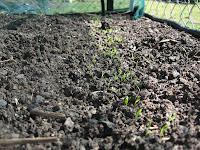
 Hopefully we will get some joy from these Snowpeas even though it will be getting a bit warm for them soon... The seedlings we bought just dont appear to be growing that well.... These are seeds we saved from last year & know that they are great producers......


